

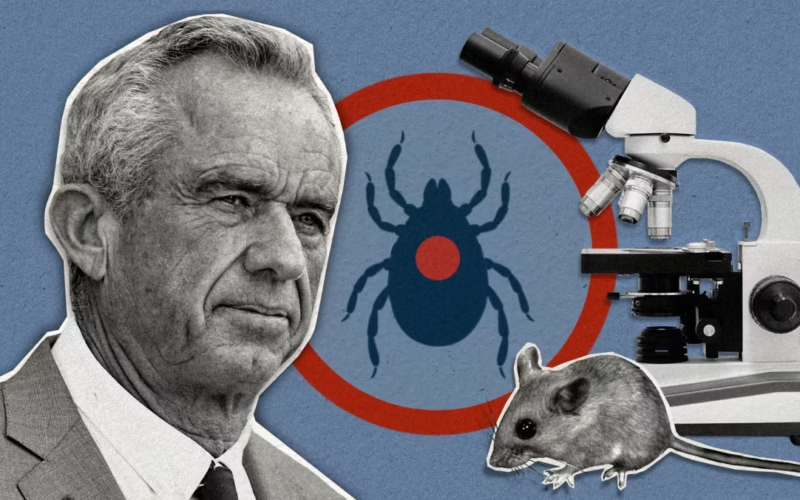
As spring comes and tick populations rise across the United States, a high-stakes standoff is brewing in the halls of the Department of Health and Human Services (HHS). The storm is centred around a long-awaited medical breakthrough and a Secretary whose own experience with the disease is as deep as his distrust of the industry that treats it.
1. A Personal War Against “The Woods”
Robert F. Kennedy Jr., the Secretary of Health and Human Services, has been very open about his goal to “make it safe for kids to go back in the woods.” His determination is personal; RFK Jr. often talks about a time in the 1980s when he pulled almost 30 ticks off of himself in one day. Kennedy has promised to change how we diagnose and treat the disease for the roughly 476,000 Americans who are diagnosed each year. This is because all of his children have had the disease, and two of them have had it very badly.
2. The Pfizer Factor: A 20-Year Wait Comes to an End
The world changed last week. Pfizer, a huge drug company, said it would ask the government for permission to sell a new Lyme disease vaccine. This would be the first new vaccine for the disease in more than 20 years.
But the vaccine’s arrival comes at a difficult time. Kennedy has long been interested in fringe theories about where Lyme disease came from, such as the unproven idea that it was a bioweapon used during the Cold War. His “MAHA” (Make America Healthy Again) platform now has a strange choice: support a vaccine from “Big Pharma” or only use antibiotics and environmental solutions.
3. Why Lyme is Winning in 2026
Disease ecologists, like Dr. Richard Ostfeld of the Cary Institute, say that the “Lyme Frontier” is growing quickly.
Climate Change: Ticks are no longer sleeping in the winter. Longer “questing” seasons mean shorter freezes.
Suburban Fragmentation: When we cut down trees to make room for houses, we make the perfect home for white-footed mice, which are the main source of Lyme bacteria. These rodents do well in “disturbed” human areas, which means they bring infected ticks right to our backyards.
4. The Lymerix Lesson: A Ghost from the 1990s
Pfizer’s biggest problem isn’t just politics; it’s history. The FDA gave the green light to Lymerix, a vaccine, in 1998. The vaccine was taken off the market in 2002.
The “Faint Praise” Problem: At the time, government agencies only gave the vaccine a lukewarm endorsement, so it wasn’t a “routine” recommendation. Because of this, the maker was open to lawsuits.
The Litigation Spiral: Even though there was no clinical proof of major safety problems, a wave of lawsuits claiming the vaccine caused arthritis, which it was supposed to stop, effectively killed the product.
5. The 2026 Outlook: Will it get approved or will there be a standoff?
If Pfizer’s vaccine gets the green light, it will have to deal with a divided public. Kennedy’s HHS might put more money into “Long Lyme” research and managing the environment than into a mass vaccination campaign.
The question to ask is: Will the government give the “routine recommendation” that the Vaccine Injury Compensation Program needs to protect the new vaccine? If they don’t, Pfizer might have to go through the same bad things that happened in the 1990s.
For the next six months, people in “Tick Country” will find out if 2026 is the year we finally get a shield against Lyme disease or if political problems keep the woods off-limits.
