

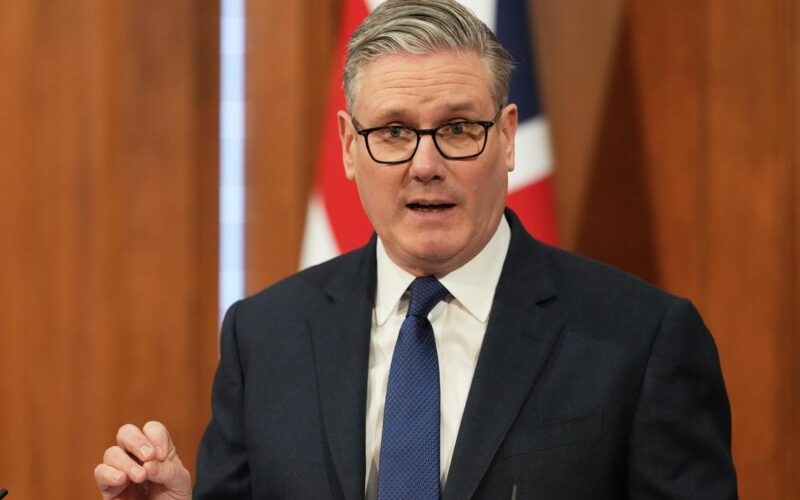
The escalating conflict in West Asia is presenting a real challenge for global leaders, who are struggling to navigate the rapidly shifting political landscape. Donald Trump, the former president of the United States, has offered a bold prediction regarding the war’s conclusion. Meanwhile, Keir Starmer, the Prime Minister of the United Kingdom, has issued a stark warning about the implications for Western security.
Starmer’s words to Europe were clear: a “new reality” is taking shape. The UK’s prime minister, Keir Starmer, spoke plainly on Wednesday.
He called on Britain and its European partners to accelerate their efforts toward military self-reliance.
Starmer said that the U.S. “won’t be there to help you anymore” and that countries need to “start learning how to fight for yourselves.” This could mean a big change in U.S. foreign policy. The Prime Minister stressed that the outcome of the Iran-Israel war would determine the future of the United Kingdom as a free country.
Trump’s Timeline and the “Force” Choice
President Trump said that the war with Iran “may be over in two or three weeks,” which is very different from what people in London were saying. The president didn’t say how this quick conclusion would happen, but reports say that a big military escalation is possible.
The Hormuz Strait: The Wall Street Journal says that the UAE is getting ready to join the U.S. and other allies in a mission to forcefully reopen the important Strait of Hormuz.
Blockade: The main goal of reopening the waterway is to stabilise the global energy markets, which have been in a tailspin since the Iranian blockade started.
Tehran Turns Down “15-Point” Peace Offer
The chances of a ceasefire are still low on the diplomatic front. On Wednesday, Iranian Foreign Minister Abbas Araghchi informed Al Jazeera that Tehran has not responded to a reported 15-point peace proposal from Washington.
“There are no grounds for negotiations,” Araghchi said, but he did say that there had been some limited back-channel messages between him and U.S. special envoy Steve Witkoff.
Escalation: Houthi Attacks and Attack on Kuwait Airport
The fight keeps spreading across borders in the region:
The Houthis in Yemen claimed responsibility for a new missile attack on Israel, which they conducted in collaboration with Hezbollah and Iran.
Kuwait Targeted: A suspected Iranian drone attack hit fuel tanks at Kuwait International Airport on Wednesday. The state news agency KUNA reported a massive fire, but fortunately, no one sustained injuries.
The Silicon Valley Threat: Deadline at 8:00 PM
The Islamic Revolutionary Guard Corps (IRGC) in Iran is now bracing for the United States’ reaction.
The tech sector is signalling a significant escalation in cyber and infrastructure warfare.
The List: 18 big companies, like Apple, Google, and Meta, have been named as possible targets for “destruction of their relevant units”.
The Trigger: Tehran says these attacks will be a response to any more “targeted assassinations” of Iranian leaders.
The Clock: The IRGC said that attacks on these companies could start as soon as 8:00 PM Tehran time (1630 GMT) tonight.
As the 8:00 PM deadline in Tehran approaches, the world remains tense. The pivotal question for 2026: Will the conflict wrap up within Trump’s proposed “three-week” timeframe, or will it instead usher in a lasting shift in global alliances, as Starmer predicts?
