

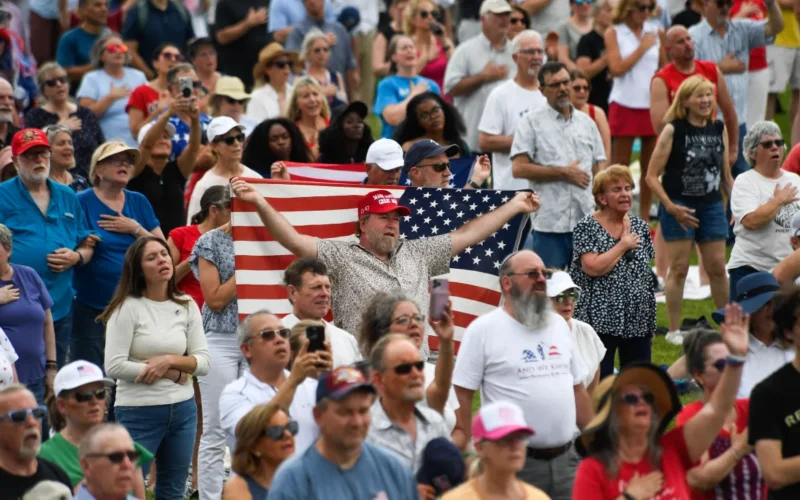
Washington, D.C. became the epicenter of a massive religious and political gathering as the Trump administration kicked off celebrations for the nation’s upcoming 250th anniversary. Billed as a historic moment of spiritual renewal, thousands of attendees packed the National Mall for an all-day, nine-hour prayer marathon aimed squarely at altering the cultural fabric of the United States.
The highly publicized event, titled “Rededicate 250: A National Jubilee of Prayer, Praise and Thanksgiving,” ran from 9 a.m. to 6 p.m. Eastern Time. According to official event organizers, the overarching mission of the day was to mark a formal, collective “rededication of our country as One Nation to God.”
High-Profile Backing from the White House and GOP Allies
The event, backed heavily by taxpayer dollars through a public-private partnership called Freedom 250, drew an extensive lineup of political heavyweights, Christian musicians, and high-profile evangelical figures.
Prominent Republican lawmakers took the stage live to connect American governance directly with biblical principles. House Speaker Mike Johnson led the boisterous crowd in a lengthy prayer of national rededication, while South Carolina Senator Tim Scott delivered an impassioned speech regarding the origin of American liberty.
“Our rights don’t come from the government. No, our rights come from God, the king of kings.”
— Senator Tim Scott
Key administrative leaders who could not attend in person sent pre-recorded video messages that played on towering screens designed to mimic church stained-glass windows.
-
President Donald Trump was filmed sitting at the Resolute Desk in the White House. He read a somber passage from the Book of Chronicles—a scripture detailing God’s promises of healing to King Solomon’s followers, alongside warnings of destruction for those who turn away.
-
Vice President JD Vance shared remarks highlighting what he views as a positive cultural shift, noting an increase in young Americans returning to church pews in search of direction.
-
Secretary of State Marco Rubio focused on the unique historical impact of the “Christian idea,” drawing a sharp contrast between Western faith and earlier civilizations which he claimed viewed history as a stagnant, repetitive cycle.
Fueling the Rise of Christian Nationalism?
Despite the celebratory atmosphere shared by the sea of attendees wearing MAGA hats and holding worship banners, the “Rededicate 250” rally sparked immediate pushback from legal scholars, civil rights advocates, and progressive religious figures.
Critics quickly pointed out that out of an expansive, hours-long schedule of speakers, only a single individual—an Orthodox rabbi—represented a non-Christian faith. This overwhelming focus led many to accuse the administration of using a federal milestone to promote Christian nationalism and whitewash the complex, multi-faith history of America’s founding.
Paul Raushenbush, a reverend and the president of the Interfaith Alliance, publically blasted the gathering as a political stunt rather than a genuine demonstration of faith. Taking to social media, Raushenbush clarified that his concerns were not rooted in anti-religious sentiment, but rather out of respect for the First Amendment.
"Rededicate 250 is a betrayal of America’s founding values guaranteed in the First Amendment – which made clear that there shall be no establishment of religion by the government and that each one of us should be free to live out our beliefs in our own way."
— Rev. Paul Raushenbush, President of the Interfaith Alliance
Blurring the Lines of the Establishment Clause
The controversy underscores a growing debate over the traditional interpretation of the Establishment Clause of the U.S. Constitution, which historically enforces a strict separation of church and state.
Watchdog groups argue that the Trump administration has repeatedly tested these legal boundaries, pointing to the implementation of routine prayer services inside the Department of Defense. In contrast, Trump has pushed back heavily against these criticisms, accusing the federal apparatus of harboring an “anti-Christian bias” and establishing a dedicated task force to investigate the matter.
Evangelical Christians remain a vital component of Trump’s core political base, and the administration has regularly mobilized faith-based messaging ahead of key voting cycles.
Data suggests this consistent messaging may be shifting public opinion. A recent survey conducted by the Pew Research Center revealed a distinct rise in the number of American adults who believe Christianity should be formally recognized as the country’s official religion—climbing to 17 percent, up from 13 percent just two years prior.
Even so, the path toward a state-recognized religion faces a steep uphill climb. The same Pew study confirmed that a clear majority of the country—roughly 54 percent—still fiercely supports the traditional separation of church and state, while 52 percent express concern that conservative Christians are pushing their religious values too far into public schools and government systems.
