

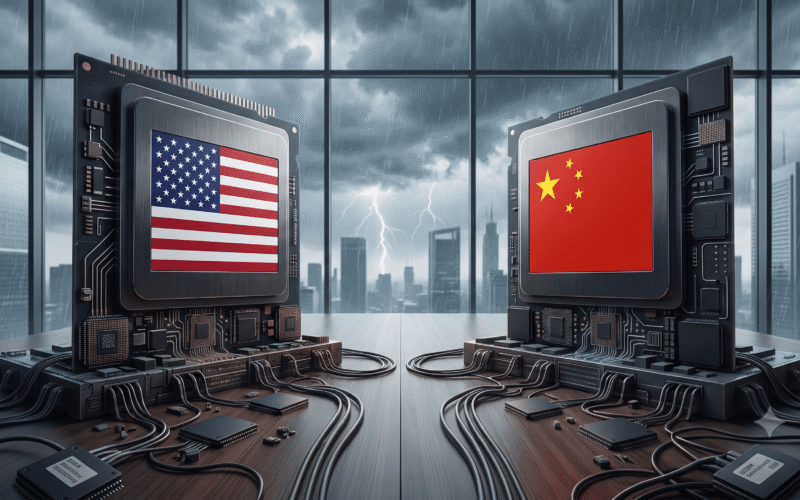
The technological rivalry between the United States and China has entered another significant chapter after Chinese technology companies reported fresh progress in developing artificial intelligence using domestically produced semiconductor hardware.
The latest development comes as Chinese technology giant Meituan announced that one of its newest large language models was trained primarily on AI chips manufactured inside China rather than relying on advanced American processors. The announcement has drawn global attention because it directly addresses one of Washington’s primary strategic objectives: slowing China’s AI progress through semiconductor export controls.
At the same time, Taiwanese authorities have expanded investigations into suspected smuggling networks involving AI servers equipped with advanced Nvidia processors that were allegedly destined for mainland China. Together, these developments illustrate how the competition over artificial intelligence is no longer limited to software. Increasingly, the battle revolves around who controls the hardware powering the next generation of AI systems.
China’s Push Toward AI Self-Reliance
For several years, China has invested heavily in building a domestic semiconductor ecosystem capable of reducing dependence on Western technology.
U.S. export restrictions have limited Chinese companies’ access to many of Nvidia’s most advanced AI accelerators, forcing businesses to search for alternative solutions.
Rather than slowing AI development completely, these restrictions have accelerated investment in local chip designers and manufacturers.
Meituan’s latest announcement suggests that at least some Chinese firms are becoming increasingly capable of training sophisticated AI models using hardware developed within China. While American chips remain the global benchmark for AI performance, domestic alternatives are improving at a faster pace than many analysts initially expected.
The achievement represents more than a technical milestone. It signals China’s determination to reduce strategic dependence on foreign semiconductor suppliers.
Why AI Chips Matter
Artificial intelligence models require enormous computing power.
That computing power comes primarily from specialized processors known as graphics processing units (GPUs) and AI accelerators.
Companies such as Nvidia have become dominant because their hardware allows developers to train increasingly complex language models, autonomous systems, and scientific applications.
Recognizing the strategic importance of these chips, the United States has tightened export controls over the past several years, arguing that unrestricted access could strengthen China’s military and technological capabilities.
As a result, semiconductor technology has become one of the most contested areas in international relations.
Export Controls Face New Challenges
The latest developments also demonstrate the growing difficulty of enforcing export restrictions.
Taiwanese investigators recently conducted raids linked to alleged efforts to move advanced AI servers containing Nvidia hardware into China through unauthorized channels.
Authorities are examining whether companies used false documentation and intermediaries to bypass existing export regulations.
The investigation highlights a broader concern shared by policymakers in Washington and allied capitals.
Even when governments restrict direct exports, sophisticated supply chains and international intermediaries can create opportunities for gray-market transactions.
Technology experts believe enforcement will become increasingly complex as demand for AI hardware continues to grow worldwide.
Nvidia Remains at the Center of the Competition
No company illustrates the AI chip race more clearly than Nvidia.
Its processors power many of the world’s most advanced artificial intelligence systems and remain highly sought after by companies developing large language models.
Restrictions on selling high-end chips to Chinese customers have significantly affected Nvidia’s business strategy over the past several years.
To comply with export regulations, the company introduced modified chips specifically designed for the Chinese market.
Even so, policymakers continue debating whether existing rules sufficiently protect national security while allowing American companies to compete internationally.
For Nvidia, balancing commercial opportunities with evolving government policy remains one of its biggest strategic challenges.
The Geopolitical Stakes Continue to Rise
The AI chip rivalry extends far beyond commercial competition.
Governments increasingly view advanced semiconductors as critical national infrastructure comparable to energy resources or defense technology.
Control over semiconductor manufacturing influences military modernization, cybersecurity capabilities, scientific research, and economic competitiveness.
For this reason, export controls have become a central feature of U.S. foreign policy toward China.
Beijing, meanwhile, has responded by accelerating investments in domestic chip manufacturing, AI software development, and semiconductor research.
The result is a technology competition with long-term geopolitical consequences.
Global Supply Chains Under Pressure
The semiconductor industry remains deeply interconnected despite rising political tensions.
Design often occurs in the United States.
Manufacturing depends heavily on Taiwan and South Korea.
Raw materials originate from multiple countries.
Assembly and integration frequently involve global supply chains stretching across Asia, Europe, and North America.
Any disruption within this ecosystem affects manufacturers, cloud providers, automotive companies, consumer electronics firms, and AI developers worldwide.
Businesses therefore continue monitoring every regulatory announcement affecting semiconductor exports.
Businesses Prepare for a New Reality
Multinational companies are increasingly adapting to a world where technology supply chains are shaped as much by geopolitics as by market forces.
Many firms are diversifying suppliers, expanding regional manufacturing, and strengthening compliance systems to manage evolving export regulations.
Technology executives also acknowledge that future AI development may depend less on accessing a single supplier and more on building resilient ecosystems capable of operating despite geopolitical uncertainty.
China’s latest progress reinforces that expectation.
Rather than relying exclusively on imported hardware, companies are investing heavily in domestic innovation.
What Comes Next?
Industry observers expect the competition to intensify throughout 2026.
Washington is likely to continue refining export control policies while strengthening cooperation with allies responsible for critical semiconductor manufacturing.
China, meanwhile, appears committed to accelerating research into homegrown AI processors capable of competing with established international products.
Whether domestic alternatives eventually match the performance of leading American chips remains uncertain.
What is increasingly clear, however, is that export restrictions alone are unlikely to determine the outcome of the global AI race.
Innovation, investment, talent, and manufacturing capacity will all play equally important roles.
Conclusion
The latest developments involving Meituan’s AI model and Taiwan’s semiconductor investigations demonstrate that the U.S.–China AI competition has entered a more complex phase.
Instead of merely restricting access to advanced technology, governments are now confronting questions about enforcement, domestic innovation, and long-term technological independence.
For businesses, policymakers, and investors, the AI chip war is no longer simply a trade dispute.
It has become one of the defining geopolitical competitions of the decade—one that will influence artificial intelligence, global commerce, and international security for years to come.
Frequently Asked Questions (FAQs)
AI chips provide the computing power required to train and operate advanced artificial intelligence models, making them essential for modern AI development.
The U.S. argues that limiting access to advanced chips helps protect national security by slowing the development of technologies with potential military and strategic applications.
Chinese company Meituan announced that one of its newest AI models was trained using domestically produced AI chips, highlighting progress toward greater technological self-reliance.
Authorities are examining alleged attempts to move AI servers containing advanced Nvidia processors into China through unauthorized channels.
Export controls, supply-chain disruptions, and changing regulations influence semiconductor availability, AI development costs, and long-term investment decisions.
Nvidia remains the global leader in advanced AI processors, although Chinese companies are investing heavily in developing competitive domestic alternatives.
