

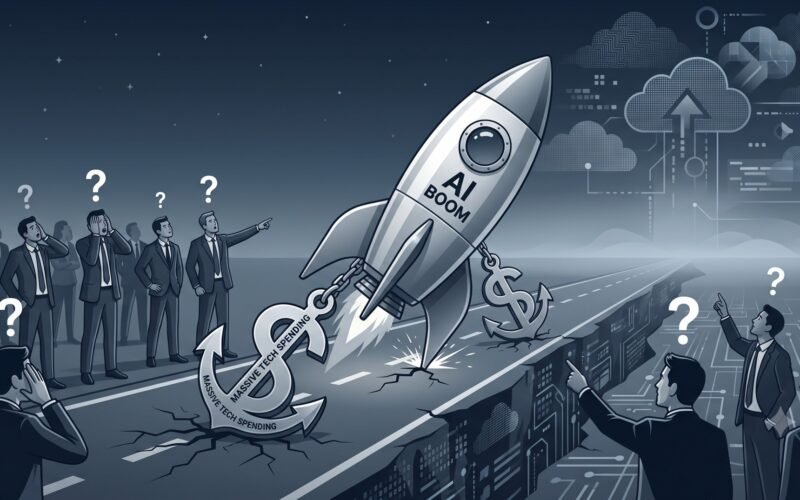
Artificial intelligence has become the defining technology race of the decade. Every week seems to bring another breakthrough model, a faster chip, or a billion-dollar investment announcement. For much of the past two years, investors have rewarded companies that promised to lead the AI revolution, sending technology stocks to record highs.
Now, however, a different question is beginning to dominate conversations across Silicon Valley and Wall Street: How much AI spending is too much?
That question gained fresh attention this week after the Bank for International Settlements (BIS) warned that the rapid pace of investment in AI infrastructure could create financial risks if companies fail to generate the returns investors expect. At the same time, market analysts noted a growing divide between chip manufacturers enjoying record demand and large technology companies spending unprecedented sums to build AI platforms.
The debate doesn’t suggest that artificial intelligence is losing momentum. Instead, it reflects a more mature stage of the AI race—one where investors are looking beyond exciting product launches and asking whether today’s spending will translate into tomorrow’s profits.
The AI Race Is Becoming More Expensive

Only a few years ago, AI development was largely confined to research labs and technology companies experimenting with new software.
Today, the landscape looks very different.
Major technology firms are collectively expected to invest hundreds of billions of dollars this year in AI infrastructure, including massive data centers, advanced networking equipment, specialized processors, and cloud computing services. Those facilities form the backbone of modern AI systems, allowing companies to train increasingly sophisticated models capable of generating text, images, videos, and software code.
Building that infrastructure is anything but cheap. A single AI data center can require thousands of high-performance chips, vast amounts of electricity, and complex cooling systems. As demand grows, the cost of expanding those facilities continues to rise.
Chipmakers Continue to Benefit
One of the biggest winners so far has been the semiconductor industry.
Manufacturers producing AI processors and memory chips have seen extraordinary demand from cloud providers racing to expand their AI capabilities. Investors have rewarded many of these companies with significant share price gains, reflecting confidence that demand for AI hardware will remain strong.
The contrast is striking.
While hardware suppliers continue reporting strong momentum, several large technology companies are facing increasing scrutiny over the enormous sums they are investing before clear financial returns become visible.
This difference has created what analysts describe as a split within the AI economy: companies selling the tools are benefiting immediately, while many of the businesses buying those tools are still working to prove that the investment will pay off.
Investors Want More Than Ambition
The excitement surrounding AI has encouraged companies to move quickly, but investors are beginning to ask tougher questions.
How soon will AI products become consistently profitable?
Will businesses pay enough for AI services to justify today’s infrastructure spending?
Can companies maintain their current investment pace without affecting other parts of their business?
These are no longer theoretical discussions. Quarterly earnings calls increasingly focus on AI-related capital expenditure and the timeline for generating measurable returns.
For investors, innovation remains important—but profitability matters just as much.
Why the BIS Warning Matters
The Bank for International Settlements is often referred to as the “central bank for central banks.” Its reports are closely followed because they frequently highlight emerging financial risks before they become mainstream concerns.
In its latest assessment, the BIS cautioned that intense competition could encourage companies to invest more rapidly than market demand ultimately justifies. If expected returns fail to materialize, businesses may be forced to reduce spending, creating ripple effects throughout the technology sector.
The warning does not predict an immediate collapse.
Instead, it serves as a reminder that every technology boom eventually reaches a stage where markets demand sustainable business models rather than ambitious projections alone.
AI Is Already Changing Business
Despite those concerns, few industry leaders believe AI adoption will slow dramatically.
Across healthcare, finance, manufacturing, education, and retail, businesses are integrating AI into everyday operations. Customer service systems are becoming more intelligent, software development is increasingly automated, and companies are using AI to analyze data at a scale that was previously impossible.
This widespread adoption explains why technology firms remain willing to invest heavily.
Executives argue that failing to build AI infrastructure today could leave them at a competitive disadvantage tomorrow.
The Next Challenge: Turning AI Into Revenue
Creating impressive AI models is only part of the equation.
The larger challenge is converting those technological advances into sustainable revenue.
Many companies are experimenting with subscription services, enterprise software, industry-specific AI assistants, and developer platforms. Others are embedding AI into existing products to improve customer experience rather than selling AI as a standalone service.
Success will likely depend on which businesses can solve real-world problems instead of simply demonstrating technical capabilities.
That shift may define the next phase of the AI industry.

What This Means for Consumers
For everyday users, the current investment boom is likely to bring more capable AI tools over the next few years.
Consumers can expect smarter virtual assistants, improved search experiences, faster content creation tools, and more personalized digital services.
However, the enormous demand for AI hardware could also influence the prices of electronic devices if supply chains remain under pressure.
The benefits of AI are becoming increasingly visible—but so are the costs of building the infrastructure that makes those innovations possible.
Looking Ahead
The debate over AI spending is unlikely to disappear anytime soon.
Technology companies remain committed to expanding their AI capabilities, while investors continue searching for evidence that these investments will generate meaningful long-term returns.
Rather than signalling the end of the AI boom, the current discussion reflects its evolution. The industry is moving beyond excitement and entering a phase where execution, efficiency, and profitability will become just as important as innovation.
The companies that successfully balance those priorities may define the future of artificial intelligence for the next decade.
Conclusion
Artificial intelligence continues to reshape the global technology landscape at an extraordinary pace, but rapid innovation comes with equally significant financial commitments.
As companies spend billions building the infrastructure of tomorrow, investors are increasingly focused on one simple question: can the AI revolution deliver returns that match its enormous promise?
The answer won’t emerge overnight. Yet the conversations taking place today may prove just as important as the next breakthrough model or the next generation of AI chips.
For the technology industry, the race has entered a new stage—one where success will be measured not only by innovation, but by the ability to turn that innovation into lasting value.
Frequently Asked Questions (FAQs)
They are building data centers, purchasing advanced chips, and developing AI platforms to compete in a rapidly growing market that is expected to transform many industries.
Some economists believe companies may be investing faster than future demand can support, raising concerns about whether those investments will produce sufficient returns.
Major cloud providers and technology companies—including Microsoft, Amazon, Alphabet, and Meta—are among the largest investors in AI infrastructure.
No. AI adoption continues to expand rapidly. The current debate focuses on financial sustainability rather than technological progress.
Consumers are likely to benefit from more powerful AI-powered products and services, although continued demand for AI hardware could also influence technology supply chains and device costs.
