
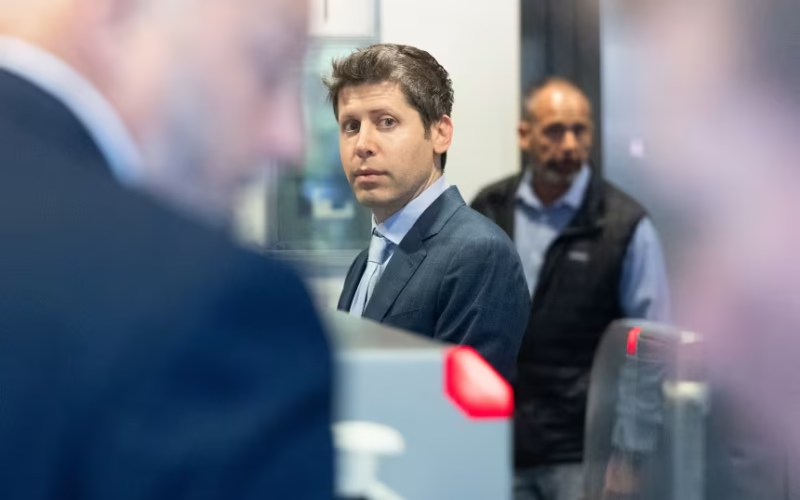
The future of artificial intelligence isn’t just being built in Silicon Valley labs; it’s currently being litigated in a federal courthouse in Oakland, California. In a dramatic week of testimony, the legal feud between Elon Musk and OpenAI CEO Sam Altman reached a boiling point, with Musk’s attorney opening his cross-examination with a blunt, five-word question: “Are you completely trustworthy?”
The trial, which has captivated the tech world, centers on Musk’s allegation that OpenAI betrayed its founding nonprofit mission to become a “de facto subsidiary” of Microsoft.
The “Hair-Raising” Quest for Control
As Sam Altman took the stand, he painted a starkly different picture of the company’s early days than the one Musk has promoted. Altman testified that Musk’s involvement in OpenAI was defined by a constant, “hair-raising” demand for total authority.
-
The Death Clause: Altman recalled a chilling moment when co-founders asked Musk what would happen to OpenAI’s control if he were to pass away. Musk reportedly replied that he hadn’t thought about it much, but that control might simply pass to his children.
-
The 90% Demand: According to testimony, Musk at one point requested 90% equity in OpenAI, insisting he would only work on companies he fully controlled.
-
The Exit: Altman suggested that Musk’s 2018 departure wasn’t a noble protest of the company’s direction, but rather a “morale boost” for staff who felt “demotivated” by Musk’s management style—which allegedly included ranking researchers to “take a chainsaw” through the team.
“A Consistent Pattern of Lying”: The Credibility War
The most bruising moments for Altman came during cross-examination by Musk’s lawyer, Steven Molo. The defense focused heavily on the chaotic week in late 2023 when Altman was briefly fired by his own board.
Musk’s legal team presented a mountain of evidence—including internal text messages and testimony from former OpenAI leaders like Ilya Sutskever and Mira Murati—alleging that Altman had a “pattern of behavior related to his honesty.”
-
The Board’s View: Jurors heard that former board members felt Altman was “misleading” and created a “toxic culture” of pitting executives against one another.
-
Altman’s Defense: On the stand, Altman admitted the 2023 ouster was an “incredible betrayal” and “very painful,” but maintained he never tried to deceive the board. He characterized the fallout as a series of “misunderstandings” rather than intentional lies.
What’s at Stake? $130 Billion and an IPO
This isn’t just a war of words; the financial implications are staggering. Musk is asking the judge for several radical outcomes:
-
The $130 Billion Clause: Musk wants a ruling that would force OpenAI to return over $130 billion to its nonprofit arm.
-
Executive Removal: He is seeking the removal of Sam Altman and President Greg Brockman from their leadership positions.
-
The 2026 IPO: OpenAI is currently valued at nearly $850 billion and has been eyeing a historic IPO later this year. A ruling in Musk’s favor could effectively “scramble” those plans, leaving the company’s commercial future in limbo.
The “Selective Amnesia” Defense
OpenAI’s legal team has countered by accusing Musk of “selective amnesia.” They argue that Musk himself proposed a for-profit structure years ago—as long as he was the one in charge. Their argument is simple: Musk is a “spurned founder” who is only suing because he’s now a competitor with his own AI company, xAI.
The Bottom Line
As closing arguments approach, the case rests on a single question: Was OpenAI’s shift to a for-profit model a necessary evolution to fund the massive computing power needed for AGI, or was it a “charitable heist,” as Musk’s team claims?
Regardless of the verdict, the trial has pulled back the curtain on the “amateur city” politics behind the world’s most powerful technology. With a ruling expected by late May, the AI industry is holding its breath.
Your Turn: Does a company have the right to change its mission if the technology it’s building becomes more expensive and powerful than anyone imagined? Let us know your thoughts.
