

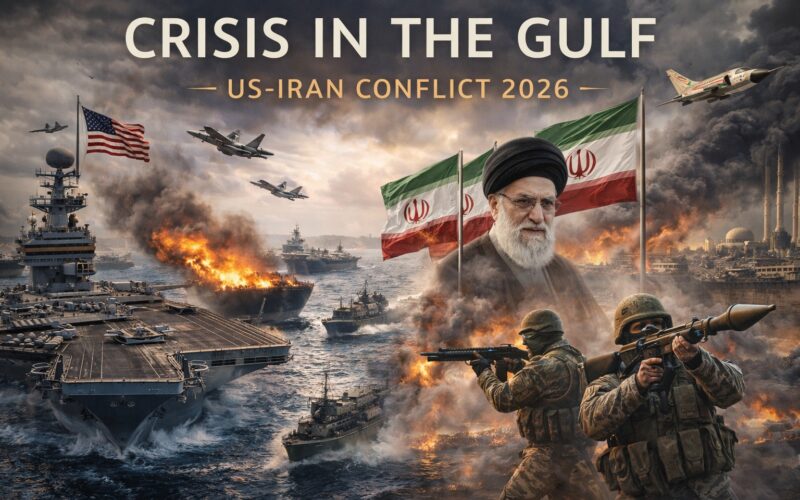
WASHINGTON D.C. / TEHRAN — The shadow of a major regional conflict has lengthened over the Middle East this week as tensions between the United States and the Islamic Republic of Iran reach a ten-year high.
Following a series of maritime skirmishes in the Strait of Hormuz and a breakdown in back-channel diplomatic talks in Oman, analysts are asking a chilling question: Are we on the brink of a formal US-Iran war?
The Flashpoint: The Strait of Hormuz
The immediate catalyst for the current escalation was an incident involving a Western-flagged oil tanker and Iranian Revolutionary Guard (IRGC) fast-attack crafts.
- The U.S. Position: The Pentagon has authorized an “increased maritime protection footprint,” moving a second carrier strike group into the Gulf of Oman.
- The Tehran Response: Iran has characterized the move as “unjustified provocation,” warning that any interference with its territorial waters will be met with a “crushing response.”
3 Key Factors Driving the 2026 Tension
1. The “Breakout” Clock
Intelligence reports shared with the UN Security Council suggest that Iran’s nuclear enrichment capabilities have reached a critical threshold. Unlike previous years, the window for a “diplomatic snapback” has nearly closed. The U.S. administration is under immense domestic pressure to ensure Iran does not achieve “threshold state” status.
2. The Proxy War Surge
From the Levant to the Red Sea, Iranian-backed groups have increased their coordination. For the U.S., the strategy of “containment” is being challenged by a “unified front” of non-state actors. Recent drone strikes on regional bases have forced a shift from defensive posturing to talks of “pre-emptive deterrence.”
3. Energy Security in a Volatile Year
With the 2026 World Cup approaching and global energy markets already sensitive to the ongoing “Economic Nationalism” trends, any disruption to the Strait of Hormuz—where 20% of the world’s oil passes—would be catastrophic. A war would not just be military; it would be a global economic earthquake.
What Happens Next? (The “Red Lines”)
Diplomatic sources indicate that three “Red Lines” currently exist that could trigger a full-scale kinetic conflict:
- Closure of the Strait: If Iran attempts to block global shipping, U.S. military intervention is almost certain.
- Direct Strike on U.S. Assets: A high-casualty event involving U.S. personnel would likely bypass Congressional debate for an immediate retaliatory strike.
- Cyber Warfare Escalation: Experts warn that the “First Shot” of a 2026 war might not be a missile, but a massive cyber-attack on critical national infrastructure (CNI) in either Washington or Tehran.
The Diplomatic Hail Mary
Despite the war drums, a small group of mediators led by Switzerland and Qatar is still pushing for a “De-escalation Roadmap.” The hope is a “Freeze-for-Freeze” agreement—where Iran halts enrichment in exchange for partial sanctions relief—but in the hyper-polarized climate of 2026, trust is a rare commodity.
Final Thought: The High Stakes of Miscalculation
In 1914, the world “walked into war” through a series of accidents and alliances. In 2026, the speed of digital communication and AI-driven military tech means a single “miscalculation” by a local commander in the Gulf could trigger a global conflict before the diplomats even reach the table.
The world is watching. The next 72 hours are critical.
