

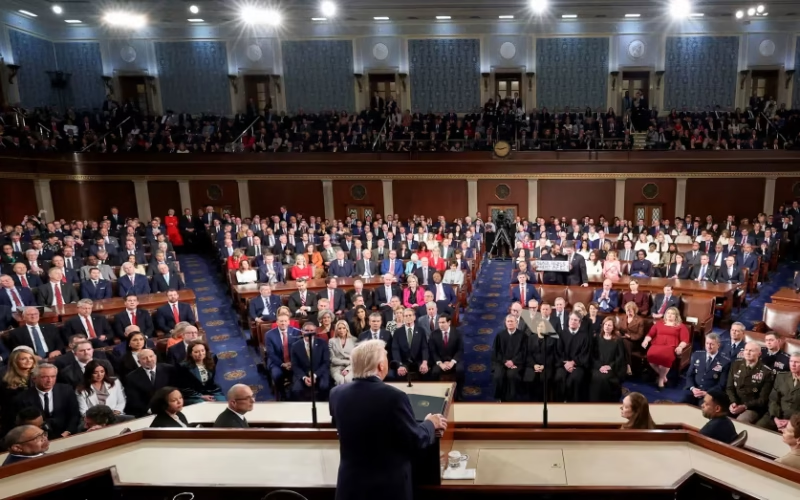
The State of the Union is always a high-stakes moment for any president to set the narrative for the year ahead. In his latest address, President Trump painted a picture of an economy “roaring like never before.” However, when you look at the hard data from the Department of Labor and independent analysts, the “scorching” economy described on stage doesn’t quite match the numbers on the page.
Here is a closer look at the key claims versus the actual facts.
1. The “$18 Trillion” Investment Mystery
One of the most eye-popping figures mentioned was the claim that $18 trillion in foreign investment has poured into the U.S. over the last 12 months.
The Reality: That number appears to be largely fictional. Even the White House’s own official tracking website lists “major investment announcements” at under $10 trillion. Furthermore, independent reviews of these “announcements” found they often include vague pledges of “bilateral trade” or “economic exchanges” rather than concrete, new investments in American soil.
2. The Gas Price Disconnect
Fuel costs are a major pain point for American families, and the President claimed that gas is now below $2.30 a gallon in most states, with some seeing $1.99.
The Reality: While gas prices have indeed trended downward since January 2025 (dropping from a national average of $3.12 to about $2.95), the $1.99 price point is nearly non-existent. According to GasBuddy, only about 0.003% of the 150,000 stations in the U.S. were selling gas for under $2.00 on the night of the speech. In most states, the average remains closer to $2.60.
3. Did Trump “Inherit” Record-High Inflation?
A recurring theme in the speech was that the current administration inherited “record levels” of inflation from the Biden era.
The Reality: This is a significant overstatement. While inflation did hit a 40-year peak of 9.1% back in mid-2022, it had already cooled significantly by the time the transition happened. In January 2025, the rate was at 3.0%. For context, the “all-time” record for U.S. inflation was actually 23.7%, set way back in 1920. Currently, inflation sits at 2.4%—a positive trend, but not a recovery from “record-breaking” levels inherited at the start of the term.
4. The Truth About Grocery Bills
The President correctly pointed out that some items, like eggs, butter, and chicken, have become cheaper recently. However, this cherry-picked list doesn’t tell the whole story of the supermarket aisle.
The Reality: Overall grocery prices are still up an average of 2.1% since the beginning of 2025. While individual items fluctuate, the average American’s total grocery bill is higher today than it was a year ago. Beef, for example, might have dipped slightly last month, but it remains 15% more expensive than it was at the start of 2025.
5. Who Really Pays for Tariffs?
A common claim made during the address was that foreign countries are paying billions in tariffs to the U.S. treasury.
The Reality: This remains a fundamental misunderstanding of how tariffs work. Tariffs are taxes paid by U.S. importers (American companies), not the exporting country. Data from the Federal Reserve Bank of New York indicates that roughly 90% of the economic burden of these tariffs is actually being covered by American businesses and consumers through higher shelf prices.
6. Is the Economy “Roaring”?
The speech described an economy that was “stagnant” a year ago and is now “scorching.”
The Reality: The data shows a more tempered reality. Economic growth in 2025 was 2.2%, which is actually lower than any year of the previous administration (partially due to the fall 2025 government shutdown). Additionally, unemployment ticked up from 4.0% to 4.3% over the last year, and job growth in 2025 was the lowest it has been since the pandemic hit in 2020.
Final Thoughts
While there are certainly positive trends to point to—such as a general decline in inflation and lower gas prices compared to two years ago—the “record-breaking” superlatives used in the State of the Union don’t quite hold up under the microscope. For voters, the real test isn’t the numbers cited on a teleprompter, but how their bank accounts feel at the end of the month.
