

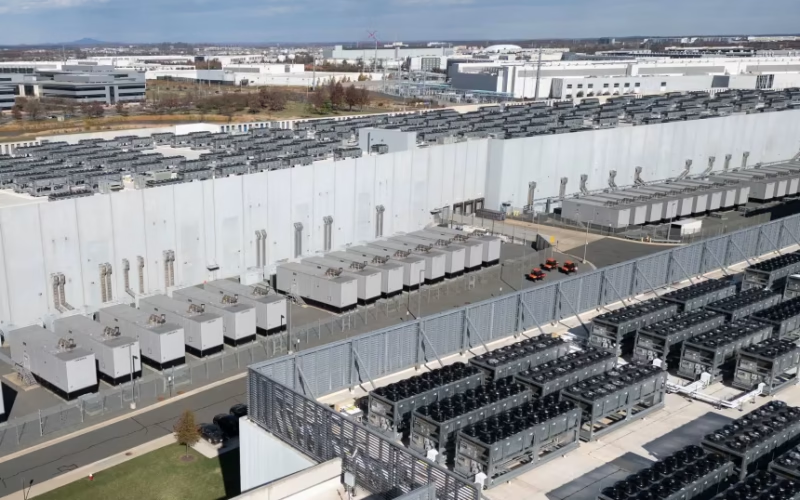
For a long time, people have been worried about how much energy AI uses. But a new study from the University of Cambridge has found a more immediate and localised threat. AI “hyperscalers” are data centers that cover millions of square feet. They are literally baking the land around them, making fake heat islands that affect more than 340 million people.
Research led by Associate Professor Andrea Marinoni shows that these digital hubs are raising surface temperatures by an average of 3.6°F, with some cases going as high as 16.4°F.
Research led by Associate Professor Andrea Marinoni shows that these digital hubs are raising surface temperatures by an average of 3.6°F, with some cases going as high as 16.4°F.
1. Charting the “Digital Fever”
The research team looked at 20 years’ worth of satellite and remote sensor data. They took out seasonal changes and general global warming trends to focus on the effects of data centers. They looked at 6,000 places that weren’t in big cities to make sure the heat wasn’t coming from homes or factories.
The outcomes were consistently unsettling:
The Radius of Impact: The heat radiates far beyond the immediate vicinity, potentially affecting areas as far as 6.2 miles (10 km) from the structure.
Global Hotspots: The emergence of massive AI server farms in Mexico’s Bajio region and Spain’s Aragon province triggered a 3.6°F temperature increase, the cause of which remains unclear.
2. What makes AI more popular than other tech
AI-specific “hyperscalers” do very dense calculations that make a lot more heat than regular data centers.
The Cooling Paradox: These centers have huge industrial cooling systems to keep servers from melting. These systems don’t “destroy” heat; they just move it from the building to the outside world.
Deborah Andrews, a sustainability professor at London South Bank University, observes that the “AI gold rush” is now infiltrating sustainable design. We’re racing ahead, perhaps too quickly.
3. A Social Crisis on the Horizon
The AI industry could grow three times as big by 2030, which could have a “dramatic” effect on the environment.
Welfare and Economy: Adding 16°F to a region that is already experiencing heat waves caused by climate change could make some areas unlivable or raise the cost of living significantly because of the need for air conditioning.
Ralph Hintemann, a researcher at the Borderstep Institute, and others argue that the carbon emissions from the energy used to run these centers are still the biggest problem. However, this study shows that the physical heat produced is a significant, but often ignored, byproduct.
Can the core be cooled?
Professor Marinoni hopes this research will lead to a “different path” for AI progress that doesn’t hurt local climates in order to get more computing power. Some ideas are:
Liquid cooling is better than air cooling, but it’s also more expensive to set up.
Waste Heat Recovery: This is when data centers use the heat they make to heat homes or provide hot water to nearby towns (common in Nordic countries).
Strategic Siting: Putting hyperscalers in places that are naturally cooler or offshore to lessen the “Heat Island” effect on people.
As we move toward a future that is more “intelligent,” we may be making the real world too hot to handle. The AI “Heat Island” is a new reminder that everything you do online has a real-world effect.
