


Artificial intelligence has become one of the most talked-about technologies in the world, driving investments worth billions of dollars and reshaping industries ranging from healthcare and finance to manufacturing and retail. Yet despite the headlines and growing excitement, new research suggests that most businesses are still only scratching the surface when it comes to integrating AI into their daily operations.
A new study released by researchers affiliated with the European Central Bank found that while more than 70% of surveyed companies report using artificial intelligence in some form, only 7% can be classified as intensive users of the technology. The findings reveal a significant gap between AI experimentation and true business transformation.
The report arrives at a time when technology companies are accelerating investments in AI infrastructure, enterprise software, and cybersecurity solutions, signaling that the race to become an AI-powered business is only just beginning.
The Difference Between Using AI and Building Around AI
For many organizations, AI adoption currently means using chatbots, content-generation tools, or workflow assistants to improve productivity.
However, experts argue that genuine transformation occurs when AI becomes deeply embedded in business processes rather than functioning as a standalone tool.
According to the ECB research, most companies remain in the early stages of adoption, focusing primarily on cost reduction and operational efficiency. Businesses that use AI intensively are more likely to leverage the technology for innovation, growth strategies, product development, and customer experience improvements.
This distinction is becoming increasingly important as executives seek measurable returns on their AI investments.
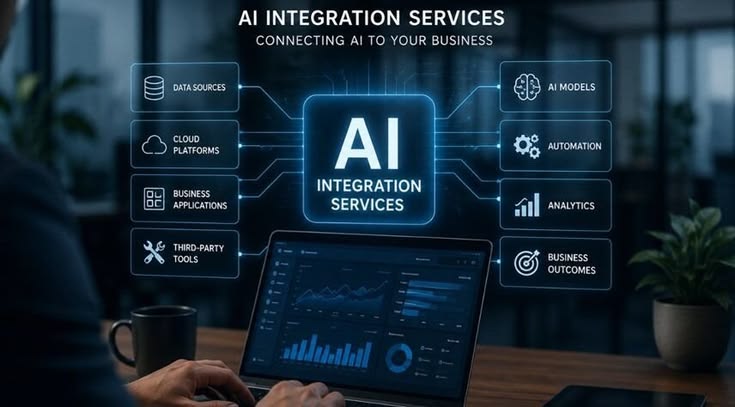
Why Enterprise AI Remains a Work in Progress
Despite the rapid pace of innovation, integrating AI across an entire organization is far more complex than deploying a chatbot.
Large enterprises often operate with decades-old software systems, fragmented data environments, regulatory requirements, and multiple departments with different operational needs.
Technology leaders have repeatedly noted that while AI tools are becoming more powerful, widespread organizational adoption remains a major challenge. Many companies continue to test pilot programs rather than committing to full-scale implementation.
Industry observers say successful AI deployment requires more than technology. It also demands employee training, governance frameworks, security protocols, and cultural adaptation.
For many businesses, these requirements represent the biggest barriers to progress.
Tech Giants Are Investing Billions to Accelerate Adoption
While businesses navigate implementation challenges, technology companies continue pouring resources into AI development.
Across the industry, major players are expanding data center capacity, developing proprietary AI models, and creating new enterprise solutions designed to attract corporate customers.
The competition has intensified significantly throughout 2026 as companies seek to position themselves at the center of the next wave of digital transformation.
Microsoft has expanded efforts to develop AI capabilities tailored specifically for business customers, while Meta has entered the enterprise market with AI-powered business agents capable of handling operational tasks such as scheduling, customer communication, and workflow automation.
At the same time, businesses are increasingly demanding AI systems capable of taking actions rather than simply generating responses.
This shift toward “agentic AI” is becoming one of the most important trends in enterprise technology.
India Emerges as a Major AI Growth Market
India continues to strengthen its position as one of the world’s fastest-growing AI markets.
Technology companies are expanding investments in the country as businesses embrace AI-powered solutions across sectors.
Industry leaders have highlighted India’s strong digital infrastructure, growing technology workforce, and increasing appetite for innovation as key factors driving adoption.
Recent initiatives by major corporations also demonstrate how rapidly AI is moving from experimentation to deployment.
Several large enterprises have begun integrating AI tools directly into employee workflows, signaling a broader shift toward AI-enabled workplaces.
For global technology firms, India is increasingly viewed as both a massive consumer market and a critical innovation hub.
Cybersecurity Becomes a Growing Concern
As AI adoption accelerates, security concerns are becoming more urgent.
This week, intelligence agencies from the Five Eyes alliance issued a rare warning that advanced AI systems could significantly increase the sophistication and speed of cyberattacks against governments, businesses, and critical infrastructure.
Officials warned that malicious actors are already using AI to automate parts of cyber operations, reducing the time needed to identify and exploit vulnerabilities.
The warning has prompted renewed discussions around AI governance, cybersecurity investments, and risk management.
Experts increasingly believe that future enterprise AI strategies must include strong security frameworks from the beginning rather than treating cybersecurity as an afterthought.
Workforce Transformation Is Already Underway
One of the most debated aspects of AI adoption remains its impact on employment.
Technology companies continue to emphasize that AI will augment workers rather than replace them entirely. However, recent developments suggest the workforce is already being reshaped by automation initiatives.
Several organizations have acknowledged restructuring efforts linked to AI-driven efficiency programs as they redirect resources toward infrastructure and advanced technology projects.
At the same time, technology executives argue that AI will create new opportunities requiring specialized skills in areas such as data science, prompt engineering, AI governance, cybersecurity, and machine learning operations.
The challenge for businesses will be balancing automation with workforce development.

The Rise of AI-Powered Business Operations
Perhaps the most significant trend emerging in 2026 is the transition from AI assistants to AI operators.
Traditional AI systems help users complete tasks. Newer systems are increasingly designed to perform tasks independently.
These systems can schedule meetings, analyze reports, monitor security risks, generate software code, summarize communications, and coordinate workflows with minimal human intervention.
Industry analysts believe this evolution represents the next major phase of enterprise AI adoption.
Organizations that successfully integrate these capabilities may gain substantial productivity advantages over competitors still relying on manual processes.
What Comes Next?
Although AI adoption continues to grow rapidly, the evidence suggests that most organizations remain in the early stages of their transformation journey.
The next few years will likely determine which companies successfully move from experimentation to full-scale integration.
Businesses that invest in infrastructure, employee training, cybersecurity, and operational redesign may unlock significant competitive advantages. Those that hesitate risk falling behind as AI becomes a core component of modern business operations.
What is becoming increasingly clear is that AI is no longer a future technology.
The debate has shifted from whether businesses should adopt AI to how quickly they can implement it effectively and responsibly.
Conclusion
The latest research highlights an important reality behind the AI boom. While adoption rates are increasing worldwide, true enterprise integration remains relatively rare.
For business leaders, the message is clear: deploying AI tools is only the first step. The real challenge lies in transforming organizations to fully leverage the technology’s capabilities.
As investment, innovation, and competition continue to accelerate throughout 2026, the companies that successfully navigate this transition are likely to define the next era of digital business.
Frequently Asked Questions (FAQs)
The research found that while more than 70% of companies report using AI, only a small percentage use it intensively across their operations.
Challenges include legacy systems, data management issues, employee training requirements, security concerns, and regulatory compliance.
Enterprise AI refers to the use of artificial intelligence across business operations to improve productivity, automate tasks, enhance decision-making, and drive innovation.
Security agencies warn that AI can be used to automate and accelerate cyberattacks, making organizations more vulnerable if proper defenses are not in place.
The United States remains a leader, while countries such as India are experiencing rapid growth in enterprise AI implementation and investment.
Agentic AI refers to systems capable of taking actions on behalf of users, such as completing tasks, managing workflows, and making operational decisions with limited human intervention.
